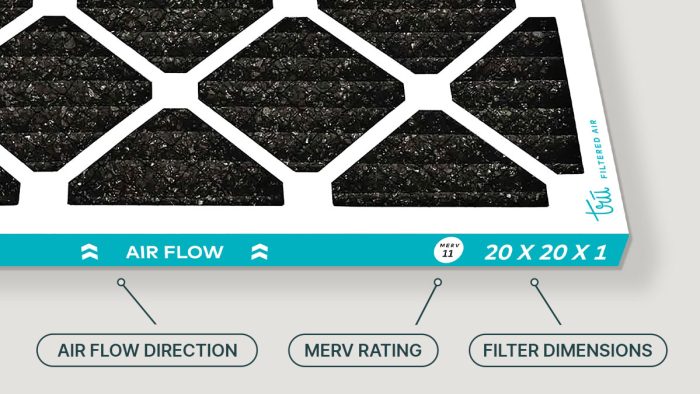

Sometimes the smallest details make a big difference. Like that little arrow printed on the side of your air filter.
At TRU Filtered Air, we’re big believers that taking care of your home’s air should be simple. Because when you’re breathing more than 20,000 times a day, the last thing you need is another complicated household chore.
We’ve already made remembering to replace your filter easy, with premium carbon-backed filters delivered automatically to your door. Now let’s make sure you’re installing them correctly.
That little arrow? It’s more important than you might think. Here’s how to get your furnace filter direction right every time, and why it matters.
Furnace filter direction rule (the only one you need)
Here’s the whole rule in one line: the arrow on your filter points in the direction of airflow. In most homes, that means the arrow points toward the furnace or air handler, because that’s where the blower fan is pulling air next.
If you want an even simpler memory trick: point the arrow at the fan. That is it. Season does not matter. Heat or AC, the air still travels from your home’s return, through the filter, and into the equipment.
This matches what you’ll see from HVAC educators like how to orient a furnace filter arrow with airflow.
Airflow direction in plain English: return side vs. blower side
Picture your HVAC system like your home breathing in and breathing out.
- Return vents are the “breathing in” points. They pull air from your rooms back to the system.
- The blower is the fan inside the unit that pulls that air in and sends it back out through the supply vents.
- The filter sits in between, so the air gets filtered before it hits the blower and the coil.
So when you’re staring at that filter slot and wondering which side is which, remember: air goes from the return toward the blower. Your arrow should follow that same path.
Why furnace filter direction matters more than people think
That arrow is not decoration. Most pleated filters are built with a “front” and “back” because one side is reinforced to handle the pressure of air being pulled through. When your furnace filter direction is correct, the filter stays sturdy, airflow stays steadier, and the filter loads in a more predictable way.
Install it backward and the system may still run, but you can run into stuff you actually notice:
- Airflow that feels a little weaker at the vents
- A filter that looks gunked up faster than you expected
- Extra strain on the blower over time
No panic needed. It is just one of those small, quiet upgrades: correct direction helps your system breathe the way it was designed to.
Furnace filter direction when the filter is in different locations
The part that trips people up is not the rule. It is the filter location. Depending on your home, your filter might be:
- In a slot on the side of the furnace
- In a filter rack at the air handler
- Behind a big return grille in a hallway wall or ceiling
Different spot, same answer: the arrow points away from the return and toward the equipment. If you want a second reference point, this is also how Vernon Air Conditioning explains furnace filter airflow direction.
Furnace filter direction by furnace type (upflow, downflow, horizontal)
The arrow always points toward the blower, but “toward the blower” can look like up, down, or sideways depending on how your system is installed. Use this as a quick visual check.
| HVAC setup | Where you usually see it | What the arrow usually points |
|---|---|---|
| Upflow furnace | Garage closet, utility room, basement | Up toward the unit |
| Downflow furnace | Some closets, slab homes | Down toward the unit |
| Horizontal unit | Attic, crawlspace, horizontal install | Sideways toward the air handler |
| Filter behind a return grille | Wall or ceiling return in living space | Into the duct, away from the room |
Furnace filter direction if there is no arrow (yes, it happens)
If your filter has no arrow, you are usually dealing with one of two situations:
- Non-directional fiberglass filters that can go either way.
- Pleated filters where the arrow is faint, missing, or printed on the packaging you already tossed.
For pleated filters, look for a sturdier side like a wire or mesh reinforcement. That reinforced side typically faces the furnace or air handler so it can handle the pull of the blower.
A no-tools, 60-second test to confirm airflow direction
If you do not want to guess which side is the return side, you do not have to. Try this quick check:
- Set your thermostat fan setting to Fan On, so air is moving.
- Hold a tissue near the filter slot or return opening.
- If the tissue gets pulled toward the opening, that is the return side.
- Your filter arrow should point away from that side and toward the blower.
Does furnace filter direction change between heat and AC?
No. The myth sticks around because it sounds logical at first, but most homes use the same blower to circulate air whether you are heating or cooling. Your system is not flipping airflow direction seasonally. So the arrow orientation stays the same all year.
A small habit that saves future-you: mark the cabinet once
Once you have it correct, take a marker and draw a little arrow on the metal next to the filter slot in the same direction. Next change, you will not even pause.
This is especially handy if more than one person swaps filters, or if you manage a rental. Clear beats clever.
Direction is important, but the fit is what makes filtration real
You can install the arrow perfectly and still miss the point if the filter is loose in the slot. Gaps around the filter frame let air sneak around the edges, and that means less air actually passes through the filter media.
This is one reason we built Tru Filtered Air in the first place. The hardware store aisle trains you to “pick the closest size” and hope for the best. Instead, we make one carbon-backed MERV 11 filter in a wide range of sizes, including ones many stores don’t stock, so you can order the exact size printed on your frame instead of playing the near-enough game.
Air Wellness: the part of your health stack you probably never meant to ignore
You already have a health stack. You move your body, you think about sleep, you filter your water, you read labels. Meanwhile, you breathe more than 20,000 times every single day, and most of us spend nearly 90% of our lives indoors. That makes indoor air the air that shapes your day.
Indoor air can be up to 5 times more polluted than the air outside, according to EPA indoor air quality guidance. Not always, not everywhere, but often enough that it belongs in the same conversation as the rest of your routine.
This is why we call it Air Wellness. Not a “maintenance task.” Just a simple, repeatable habit.
Our version stays intentionally uncomplicated: premium carbon-backed MERV 11 air filters, delivered automatically to your door, exactly when it’s time to replace them. If you want to go one layer deeper on what the rating means, you can read our guide to MERV (Minimum Efficiency Reporting Value) ratings for AC and furnace filters. And if you want to make the whole thing automatic, you can shop filters by size and set your delivery schedule.
FAQ: Furnace filter direction (quick answers)
Which way does a furnace filter go?
With the arrow pointing in the direction of airflow, which is toward the furnace or air handler and toward the blower fan.
Which way does an air filter go if it’s behind a return grille?
The arrow points into the duct, away from the room. Air is being pulled from your living space toward the blower.
What happens if you install a furnace filter backward?
It can restrict airflow sooner and may load unevenly, which can add strain to the blower over time. If you catch it, just flip it around. No shame, it happens.
My filter looks dark. Is it dirty or installed wrong?
Not automatically. Some filters are darker on one side because of materials like activated carbon. Follow the arrow first, then rely on your replacement schedule to keep things consistent.
How often should you replace an HVAC filter?
A common guideline is every three months. Homes with pets, allergies, desert dust, construction, or wildfire smoke may need a faster cadence.
Conclusion
Furnace filter direction is simple once you stop overthinking it: the arrow always follows airflow, pointing toward the blower and the HVAC unit, never back toward the return. Get the direction right, make sure the fit is snug, and you’ve handled one of the easiest ways to support better airflow and cleaner indoor air.
If you want clean air to run like the rest of your wellness routine, we can help. Tru Filtered Air makes one carbon-backed MERV 11 filter in a wide range of sizes, ships it free, and brings it back on a replacement schedule so you never have to remember. Breathing is the greatest pleasure in life. We make breathing clean air easy.